
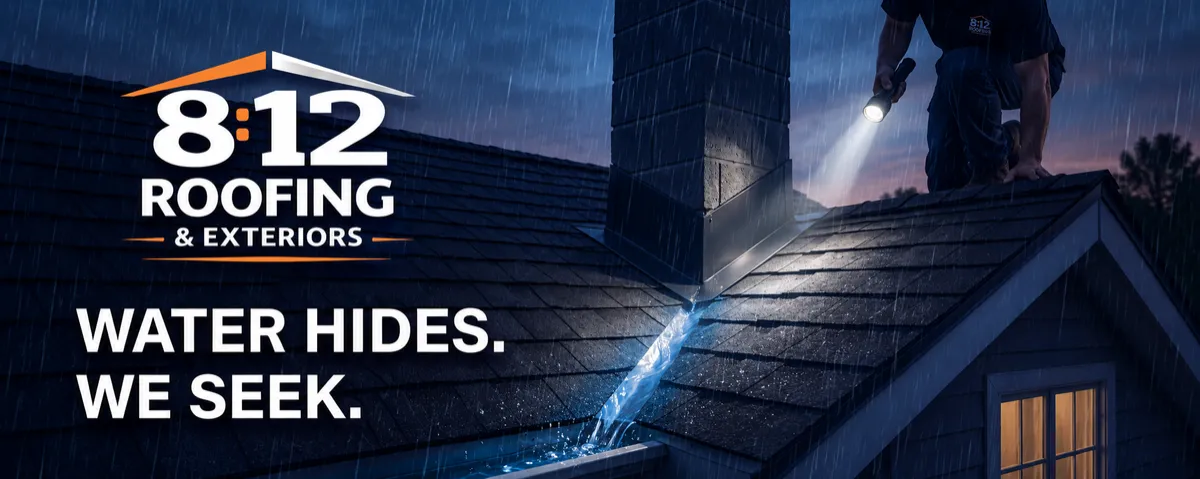
Stop Squinting at Your Chimney: The Honest Truth About Finding Stubborn Leaks
A quick glance at your roof and a documented water test are not the same thing.
A quick glance usually looks something like this: a guy stands in the driveway, squints at the roof, points vaguely toward the chimney, and says, “Hmm.” Maybe he climbs up, finds something that looks suspicious, smears a generous blob of roofing tar around it, and heads home feeling pretty confident. Problem solved, right?
Not necessarily.
Roof leak detection requires more than finding something that looks suspicious. A documented water test takes a different approach. Instead of simply guessing where the leak might be, the goal is to recreate the conditions that cause the leak and identify where water is actually entering the roofing system.
When a brown water stain suddenly blooms across your living room ceiling, it is natural to assume there must be a giant hole directly above it. Unfortunately, roofs do not make things that convenient.
Water is basically nature's most annoying houseguest. It finds the smallest opening, sneaks inside, travels wherever it can, and then shows up somewhere completely different. A tiny crack near a chimney might send water several feet through the attic before it finally decides to drip onto the ceiling above your favorite chair.
That is why finding the source of a roof leak can be much more complicated than finding the visible water stain.
And things get even more interesting when Oklahoma weather gets involved.
How Wind Makes Water Go Uphill
A nice, gentle rain is fairly predictable. Water lands on the roof, runs downhill, reaches the gutter, and everybody gets on with their day.
Oklahoma thunderstorms are not always so polite.
Strong winds can drive rain against your home and push water into areas that normally keep it out. Roof flashing, shingles, siding, chimneys, windows, and roof-to-wall transitions can all become potential entry points when wind-driven rain finds a small weakness.
Think about what happens when the corner of a paper towel touches a spill. The water starts creeping upward even though gravity says it should be going down.
Your house can do something similar.
Once water gets past the exterior defenses, it can travel along wood, insulation, framing, or other surfaces before finally appearing inside. This is one reason the location of a ceiling leak does not necessarily identify the source of the roof leak.
So if your ceiling is leaking over the couch, don't automatically blame the roof directly above the couch. The water may have taken the scenic route.
For homeowners dealing with a chimney leak, roof leak after a storm, or unexplained ceiling water stain, identifying the actual entry point matters. Sealing the wrong location may stop nothing, or may only provide a temporary improvement until the next heavy Oklahoma storm.
The Problem with Guessing
When a leak is difficult to find, the temptation is to seal anything that looks suspicious. Grab some caulk. Add some roofing cement. Maybe throw in a little extra for good measure.
It is the home-repair version of putting a bandage on your elbow because your knee hurts.
You might feel like you accomplished something, but you still haven't figured out what is actually wrong.
Guesswork is one reason stubborn roof leaks can become such a frustrating cycle. You pay for a repair, everything stays dry for a while, and then the next big storm rolls through. Suddenly, that same brown stain is back on the ceiling, looking like it never left.
Now you're back where you started, except your wallet is a little lighter and your patience is considerably thinner.
The problem isn't always that someone failed to make a repair. Sometimes the problem is that nobody properly identified the source of the leak in the first place.
A proper roof leak inspection should focus on finding evidence, not simply finding something that looks like it could be the problem.
That distinction matters.
How a Real Water Test Works
Finding a stubborn roof leak requires more than standing on the ground and giving the roof your best detective impression. You have to recreate the conditions that cause the leak and carefully watch what happens.
A proper roof water test typically involves two technicians, a garden hose, a good flashlight, and a healthy amount of patience. One technician stays inside the house, usually in the attic or near the area where the leak appears. The other technician works from the roof with the hose.
The important part is that they don't simply spray water everywhere and hope something happens.
Testing starts at the lowest suspected entry point. The technician may run water along a specific area near a chimney, window, flashing, or wall transition and then wait. If nothing happens, the test moves slightly higher. Then they wait again.
It can be slow, but that is the point.
If you spray the entire roof at once, you may eventually get water inside, but you won't necessarily know where it came from. That's like throwing a bucket of water at a crime scene and then asking which drop committed the crime.
A careful water leak test narrows the search area piece by piece until the water finally reveals its entry point. The technician inside sees the water. The technician outside knows exactly what area was being tested.
The mystery starts becoming evidence.
This approach is especially valuable when a leak is intermittent, difficult to reproduce, or appears far away from the suspected source. Instead of relying on assumptions, the test creates a clearer connection between the exterior area being tested and the water appearing inside.
Documenting the Proof
Finding the leak is only half the battle. Proving where it came from is what makes the diagnosis useful.
Clear photos and video of the water test can document the exact entry point and help show what needs to be repaired. Instead of hearing, “It looks like the chimney might be the problem,” you have a documented reason for the recommended repair.
That matters because your home deserves more than a guess.
A documented roof leak diagnosis can also make the repair process easier to understand. You can see what was tested, where water entered, and why a particular repair was recommended.
Stubborn roof leaks can be incredibly frustrating, especially when they seem to disappear every time someone tries to find them. But they are not magic. They are usually the result of physics, wind, water, and a small opening hiding in a very inconvenient place.
If that mysterious ceiling stain has started feeling like a permanent resident in your house, 8:12 Roofing & Exteriors can help.
Our goal is simple: bring clarity to a problem that can otherwise feel confusing and stressful. A thorough evaluation can help determine what is happening, what options you have, and what should happen next, without pressure to make a rushed decision.
Schedule a free, no-obligation Forensic Roof Assessment to have your home thoroughly evaluated, the testing documented, and the problem properly diagnosed.
Because when water keeps showing up where it shouldn't, the answer isn't always another tube of caulk.
Sometimes, you just need to find the truth.
Schedule your FREE, no-obligation Forensic Roof Assessment here: www.812roofing.pro/fra