Wind Damage 101: Why Missing Shingles Aren’t the Only Sign of Roof Damage
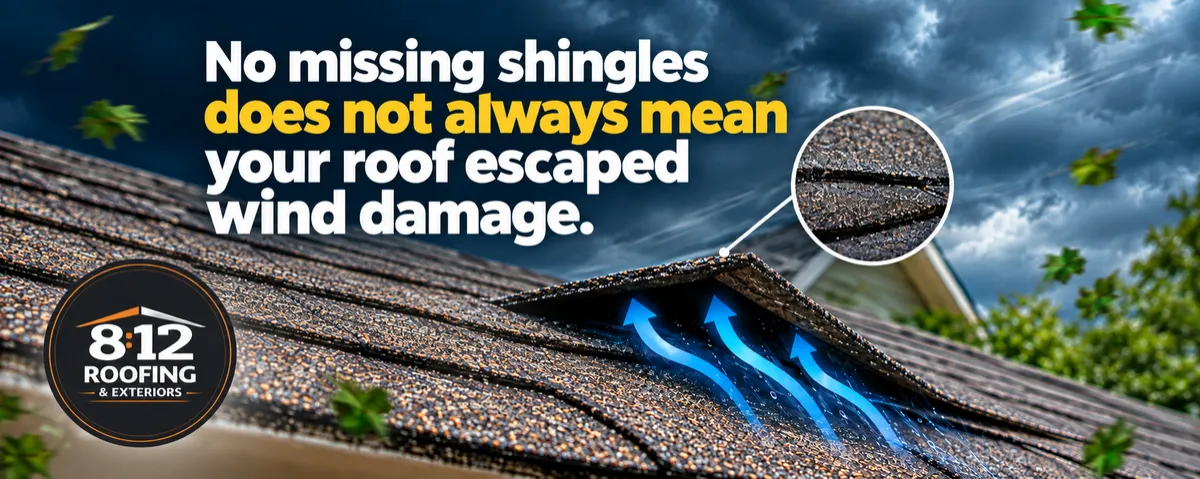
No missing shingles does not always mean your roof escaped wind damage.
After a severe Oklahoma storm rolls through, most homeowners do the same thing: walk into the driveway, look up at the roof, and scan the yard. If there are no shingles scattered across the grass and no obvious bare spots on the roof, it is easy to assume everything is fine.
That quick look can be misleading.
Some of the most important signs of wind damage on an asphalt shingle roof are not obvious from the ground. Two examples are broken shingle seals and creased shingles. The shingles may still be in place and the roof may look normal from the street, while the damage is already affecting how the roof performs.
Understanding what wind can do to shingles, even when nothing appears to be missing, can help Oklahoma homeowners catch problems before they turn into expensive leaks and roof repairs.
The Physics of Wind Uplift: How Shingles Are Designed to Work
Modern asphalt shingles are designed to stay in place using two primary components:
Mechanical fasteners: Roofing nails secure the shingles to the roof deck.
Thermal sealant strips: Factory-applied adhesive strips bond each shingle to the course below it once the sealant is activated by heat.
During high winds, air moving across the roof creates wind uplift pressure. That pressure can pull upward on the exposed edges and tabs of the shingles.
When the force becomes strong enough, the shingle can lift and the adhesive bond can break.
The shingle may not fly away. It may simply settle back into position after the wind stops.
That is where hidden wind damage becomes a problem.
1. Broken Shingle Seals: Damage You May Not See
A broken seal can be one of the easiest forms of wind damage to overlook.
When the adhesive bond between shingles is broken, the shingle can remain flat and appear perfectly normal from the driveway. But the loss of that bond can leave the shingle more vulnerable to future wind and moisture intrusion.
Why a broken seal matters
Wind-driven rain: During a future storm, rain pushed by strong winds can find its way beneath a shingle that is no longer properly sealed.
Repeated movement: Once a shingle is no longer securely bonded, even ordinary wind can cause the shingle to lift and move. Repeated movement can put additional stress on the shingle.
Moisture-related problems: Water that gets beneath the shingle layer can reach areas around fasteners and roof decking, potentially contributing to deterioration over time.
Progressive damage: A roof that looks fine immediately after a storm may develop more visible problems later as already-weakened shingles continue to move.
The important point is simple: a shingle does not have to be missing to have sustained wind damage.
2. Creased Shingles: A More Serious Sign of Wind Damage
A broken seal can allow a shingle to move repeatedly during strong winds. In some cases, that movement results in a creased shingle.
A crease is typically a sharp bend or fracture that develops across the shingle, often near the nail line or in an area affected by wind uplift.
This is more than a cosmetic issue.
When a shingle bends sharply, the fiberglass reinforcement and asphalt material can be damaged. The result can be a weakened shingle that is less capable of protecting the roof from weather.
Why creased shingles deserve attention
Granule loss: The protective granules on the surface of the shingle can loosen or break away along the damaged area.
Exposed asphalt: Once the surface is damaged, the underlying asphalt can be more exposed to sunlight and weather.
Premature deterioration: Continued exposure to heat, UV radiation, wind, and moisture can accelerate deterioration in an already-damaged shingle.
Greater risk during future storms: A shingle that has already been bent or weakened may be more likely to tear, lift, or fail during another period of high wind.
A crease can be a strong indicator that the shingle experienced significant movement during a storm, even when the roof still looks intact from the ground.
Why Driveway Inspections Can Miss Wind Damage
This is why a post-storm driveway inspection is not enough to tell you whether your roof is actually okay.
From the ground, you may notice:
Missing shingles
Large bare areas
Obvious holes
Tree or debris damage
Those are important signs, but they are not the only ones.
Broken seals, subtle creasing, lifted shingle edges, and other forms of wind damage can be difficult to spot without getting close to the roof.
A roof can look completely normal from 30 feet away and still have damaged shingles that deserve attention.
That is especially important in Oklahoma, where strong winds and severe storms can put considerable stress on roofing systems.
The goal after a storm should not be to ask, “Can I see anything missing?”
A better question is:
“Did the storm affect the condition or performance of my roof?”
Get Facts, Not Assumptions: The Forensic Roof Assessment
At 8:12 Roofing & Exteriors, we believe homeowners deserve clear information about the actual condition of their roofs.
That is why we offer a free and no obligation Forensic Roof Assessment (FRA) designed to document what is really happening on your roof rather than relying on a quick visual guess.
During the assessment, a trained technician closely evaluates the roof covering for signs of storm and wind damage, including issues such as broken shingle seals, creased shingles, lifted areas, and other visible conditions. When appropriate, photo documentation helps give homeowners a clear record of what was found.
The purpose is simple: give you useful information so you can make an informed decision.
Your roof may need a repair. It may need replacement. Or it may be in good condition and simply need confirmation.
Knowing which situation you are dealing with is a lot more useful than guessing from the driveway.
Is Your Roof Holding Up Against Oklahoma Winds?
A storm does not have to leave shingles in your yard to cause roof damage.
Broken seals and creased shingles can be signs that your roof has already been affected by wind, even when the roof still looks intact.
If you want clear, photo-backed information about your roof's condition, schedule a free and zero-obligation Forensic Roof Assessment with 8:12 Roofing & Exteriors.
Call 405-500-1909 or click here to schedule your Free and no obligation Forensic Roof Assessment today: www.812roofingpro.com/fra
Oklahoma CIB Reg # 80007114