Chimney Leaks: Stop Blaming the Brick. Check the Flashing First.
That ugly water stain around your fireplace might have a whole lot more to do with your roof than your chimney. Here's what homeowners need to know before spending good money fixing the wrong thing.
Before You Call a Mason, You Might Want to Call a Roofer
There's nothing quite like sitting in your living room, looking up at the ceiling, and discovering a nice brown water stain that wasn't there last week. Even better when it's right next to your fireplace, because now you've got the pleasure of wondering whether your chimney is falling apart and how much that little surprise is going to cost.
Naturally, most homeowners look at the chimney and assume the bricks or mortar must be the problem. It's a reasonable guess. After all, that chimney has been sitting up there taking a beating from the weather for years, and chances are nobody's paid much attention to it since the house was built.
But before you start calling masonry contractors or entertaining the idea of rebuilding half your chimney, there's something else you ought to have checked.
The flashing.
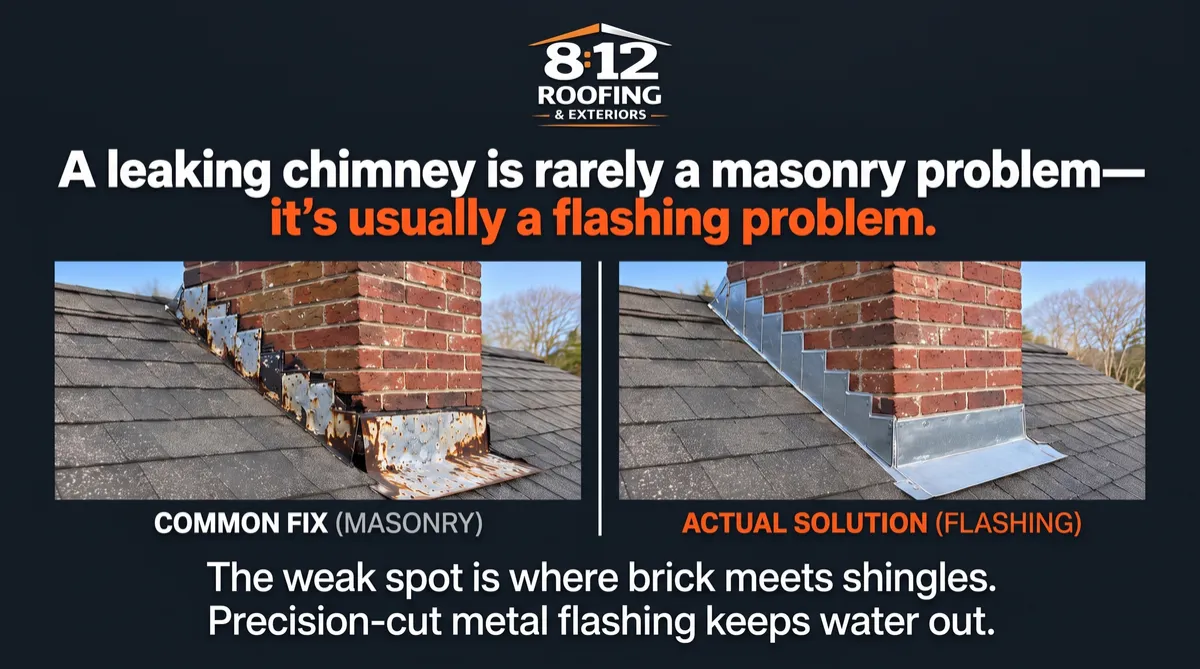
Chimney flashing is one of the most common sources of roof leaks around fireplaces, and it's also one of the most overlooked. I've seen enough home repairs over the years to know that people can spend a small fortune fixing what they think is wrong, only to discover later that the real problem was something entirely different.
And while bricks, mortar, and chimney crowns certainly can fail, the area where your chimney meets your roof is an especially vulnerable spot. It's constantly exposed to rain, wind, heat, cold, and the natural movement of your home.
That's a lot to ask of a few pieces of metal, especially if somebody didn't install them correctly in the first place.
What Is Chimney Flashing, Anyway?
Flashing is simply thin metal, usually aluminum, galvanized steel, or copper, that's installed around the base of your chimney where it passes through the roof. Its job is to direct rainwater away from that joint and back onto the shingles, where it can continue downhill and eventually find its way into your gutters or off the edge of the roof.
Sounds simple enough, and it really is. At least in theory.
The problem is that properly flashing a chimney requires several pieces working together, and they all have to be installed in the right order. It's not something you accomplish by bending a little sheet metal around the bricks and calling it a day.
Here's how the system works:
Base flashing (apron flashing): This protects the downhill side of the chimney, where water needs to flow away from the brickwork and back onto the roof.
Step flashing: These are individual pieces of metal installed along the sides of the chimney, overlapping each other and the shingles like steps on a staircase. Each piece helps guide water downhill without letting it slip underneath the roofing materials.
Counter flashing: This overlaps the step flashing and is typically secured into the chimney's mortar joints. Its job is to keep water from getting behind the flashing as it runs down the sides of the chimney.
Chimney cricket (saddle): This is a small peaked structure built behind certain chimneys, usually wider ones, to split rainwater and direct it around the sides instead of allowing it to collect against the brick.
When everything is installed correctly, the system does its job without anybody giving it much thought. Water comes down, flashing sends it around the chimney, and everybody stays dry.
But get the overlaps wrong, leave a gap, or fail to secure the counter flashing properly, and you've created an opening for water to enter your home.
And water, as I've learned, is pretty darn good at finding an opening.
Why Chimneys Are Such a Common Trouble Spot
Your chimney and your roof might look like they're part of the same solid structure, but they're actually two very different things that don't always get along as well as we'd like.
For starters, they're made from different materials. Brick, wood, metal, and asphalt shingles all expand and contract at different rates as temperatures change. On a hot Oklahoma afternoon, your shingles can get incredibly hot, while the brick chimney responds differently to that same heat. Then the sun goes down, temperatures drop, and everything starts cooling off again.
That happens day after day, year after year, and all that movement puts stress on the joints where those materials meet.
Your house also moves slightly over time. Foundations settle, wood framing expands and contracts, and roof structures shift a little with changes in temperature and moisture. Meanwhile, a traditional masonry chimney is a big, heavy structure that's often supported by its own foundation.
In other words, your roof and chimney aren't necessarily moving together.
That's one reason flashing has to be installed in a way that allows for normal movement while still keeping water out. When somebody relies too heavily on rigid patches or sealants, that natural movement can eventually cause those repairs to crack or pull apart.
Then there's the weather.
Here in Oklahoma and the Texas Panhandle, we get everything from blistering summer heat to freezing temperatures, hail, high winds, and thunderstorms that occasionally make you question whether the house was built in the right state.
That kind of weather is hard on roofing materials, and the chimney flashing is no exception.
The other thing worth understanding is that water doesn't need much of an opening. A tiny gap, a loose piece of metal, or a poorly sealed joint can be plenty, especially when the wind is blowing rain sideways.
And once water gets underneath your roofing materials, it can travel along the roof decking, framing, or other surfaces before finally showing up inside your house. That means the stain on your ceiling might not even be directly below the actual leak.
Which is one more reason why guessing at the problem can get expensive.
The Great Roofing Tar Experiment
If you've ever looked at an older chimney and seen what looks like half a bucket of black roofing tar smeared around the bottom, there's a pretty good chance somebody's been chasing a leak.
Maybe once. Maybe three times. At some point, you have to wonder whether they're fixing the roof or trying to waterproof the entire chimney with driveway sealer.
Now, roofing tar, caulk, and other sealants do have legitimate uses. Certain flashing details require the right sealants, properly applied, and there's nothing wrong with that.
The problem comes when somebody tries to use them as a substitute for properly installed metal flashing.
Over time, exposure to sunlight, temperature changes, moisture, and movement can cause many of these products to shrink, crack, harden, or lose their bond with the surrounding materials. Once that happens, water finds its way right back through the same opening.
That's how homeowners end up paying somebody to patch a chimney, thinking the problem is solved, and then discovering another water stain after the next good thunderstorm rolls through.
So they call somebody else, who adds another layer of sealant. That seems to work for a while, too, until it doesn't.
Before long, you've got enough roofing tar around that chimney to pave a small driveway, and the ceiling still leaks.
If the flashing itself is improperly installed, damaged, or deteriorating, piling more material over the top isn't going to correct the underlying problem.
Sometimes a temporary patch is necessary to stop active water intrusion until a proper repair can be made. That's understandable. But a temporary repair shouldn't quietly become the permanent solution just because the rain stopped.
Seven Warning Signs Your Chimney Might Be Leaking
The good news is that many chimney leaks give you some warning before they turn into major repairs. You just have to know what to look for, and fortunately, most of these things can be spotted without climbing onto your roof.
1. Water stains around your fireplace. Brown or yellow stains on the ceiling or walls near the chimney are often the first signs of trouble. They don't automatically mean the flashing is bad, but they certainly deserve a closer look.
2. Musty smells in the attic. If the insulation or wood around your chimney is getting wet, you may notice a damp or musty odor before you see any obvious damage. Water has a way of getting comfortable in places you rarely inspect.
3. Damp wood or visible gaps around the chimney. If you can safely see the area where the chimney passes through your attic, look for water stains, wet roof decking, or openings that shouldn't be there. Visible daylight or water staining around the roof opening can point to a problem that needs attention.
4. Rusted, bent, or loose flashing. Metal that's lifting away from the shingles, pulling loose from the chimney, or showing significant corrosion may no longer be providing proper protection.
5. Excessive roofing tar or caulk. A little sealant in the right place is perfectly normal. A giant black blob surrounding the entire chimney is another story. It doesn't prove the flashing is bad, but it's a pretty good reason to ask what somebody was trying to fix.
6. Cracked or crumbling mortar near the roofline. Deteriorating mortar can allow water into the chimney itself and may also affect how securely the counter flashing is attached. Either way, it's something you don't want to ignore.
7. Peeling paint, bubbling drywall, or damp areas around the fireplace. These can indicate that moisture has been entering the structure for some time, even if you haven't noticed an active drip.
One important point here: just because water is showing up near the chimney doesn't automatically mean the flashing is responsible. Cracked chimney crowns, damaged caps, deteriorating mortar, and other roofing problems can cause similar symptoms.
That's why a proper inspection should look at the entire area instead of deciding what's wrong before anybody's even climbed onto the roof.
And speaking of climbing onto the roof, please don't turn this into a weekend adventure involving a ladder, some flip-flops, and a YouTube video. There's a reason professional roofers use safety equipment. Keep your feet on the ground and let somebody qualified handle the inspection.
Seven Ways to Prevent Chimney Leaks Before They Get Expensive
Like most things around your house, preventing a problem is usually a whole lot cheaper than repairing the damage after it's had time to get worse.
The good news is that chimney leak prevention isn't particularly complicated. It mostly comes down to good installation, regular inspections, and not ignoring the warning signs when something starts going wrong.
1. Make sure your chimney has properly installed metal flashing.
Flashing should be designed and installed to direct water away from the chimney, with each piece correctly positioned and overlapped. Sealants can help protect certain joints, but they shouldn't be the only thing standing between your living room and a thunderstorm.
2. Pay attention to the chimney when replacing your roof.
If you're having a new roof installed, ask your contractor what they're planning to do with the existing flashing. Some components may be reusable if they're in excellent condition and properly installed, while others may need to be replaced.
Personally, I'd rather have that conversation before the new shingles go on than discover six months later that we installed a beautiful new roof around the same old problem.
3. Ask whether your chimney needs a cricket.
Wider chimneys can collect a surprising amount of water and debris on their uphill side. A properly constructed cricket helps split that water and send it around the chimney instead of allowing it to sit against the brickwork.
Depending on the chimney's width and the building code that applies, a cricket may even be required. Either way, it's worth asking about if your chimney sits across a significant portion of the roof slope.
4. Have your roof inspected annually and after major storms.
An annual roof inspection is a good habit, particularly in Oklahoma and the Texas Panhandle, where severe weather isn't exactly a rare occurrence.
After a significant hailstorm or windstorm, another inspection is a smart move. Loose flashing, damaged shingles, and other small problems are much easier to deal with before water starts finding its way into your attic.
5. Keep leaves and debris away from the chimney.
Leaves, branches, and other debris can trap moisture and interfere with proper drainage, particularly on the uphill side of the chimney.
Keeping that area clear helps water move off the roof the way it's supposed to. It's simple maintenance, but simple doesn't mean unimportant.
6. Don't ignore small water stains.
This is one of those things homeowners tend to put off because the problem doesn't seem urgent. Maybe the stain is small, or maybe it only shows up after a really heavy rain.
The trouble is that the stain you see might represent only a fraction of the moisture getting into your house. Wet insulation, damaged roof decking, rotting wood, and deteriorating drywall can all develop while the visible damage still looks relatively minor.
I've never known water damage to get cheaper because somebody decided to give it another six months.
7. Hire a roofing professional who understands chimney flashing.
Proper chimney flashing takes experience, attention to detail, and an understanding of how water moves across a roof. The individual pieces aren't terribly complicated, but getting them installed correctly is a different story.
A qualified roofer should be able to explain what they're seeing, why they believe it's causing the leak, and what needs to be done to correct it.
If the entire repair plan consists of somebody pointing at your chimney and saying, "We'll just put some more goop around that," I'd probably ask a few more questions before getting out my checkbook.
Fix the Actual Problem, Not Just Whatever Looks Suspicious
One of the most frustrating things about chimney leaks is how easy it can be to spend good money fixing something that was never causing the problem in the first place.
Picture this. A homeowner notices water coming in around the fireplace, assumes the brickwork is failing, and hires a mason to repair some mortar joints. The work gets done, everything looks great, and everybody goes home happy.
Then the next big storm comes through, and there's that same ugly stain spreading across the ceiling.
So somebody else gets called out and decides the chimney needs a little more sealant. That repair holds for a few months before the leak returns. By this point, the homeowner's paid for two repairs, has a ceiling that looks like a watercolor painting gone wrong, and is starting to wonder whether the chimney has some kind of personal vendetta against him.
Eventually, a roofer takes a close look and discovers that the step flashing was improperly installed or the counter flashing had pulled away from the masonry.
There's your problem.
Now, to be fair, sometimes the brickwork really is responsible. Chimney crowns can crack, caps can fail, mortar can deteriorate, and water can penetrate damaged masonry. Those are legitimate problems that may require a mason or chimney specialist.
But that's exactly why a proper inspection is so important.
The goal isn't to prove the flashing is bad. The goal is to find out where the water is getting in and fix that specific problem.
That means looking at the condition of the flashing, shingles, chimney crown, cap, mortar, and surrounding roof materials. In some cases, additional leak testing may be necessary to identify the source.
Once you've found the cause, you can make a repair that actually addresses it instead of throwing money at whatever looks questionable.
Because there's a big difference between fixing a leak and temporarily convincing it to go somewhere else.
The Bottom Line: Give the Flashing a Good Look Before Blaming the Brick
Your chimney has a fairly straightforward job. It's supposed to provide a safe path for smoke and exhaust to leave your house while keeping the weather outside where it belongs.
Unfortunately, the area where your chimney meets the roof is one of those places where poor installation, aging materials, and years of exposure can eventually catch up with you.
If you're noticing water stains near your fireplace, don't automatically assume your bricks are falling apart or that you need expensive masonry repairs. Start by having the entire chimney and surrounding roof inspected, with particular attention paid to the flashing.
A properly installed flashing system can provide years of dependable protection, and catching a small problem early can save you from much larger repairs down the road.
And when something does need to be fixed, do yourself a favor and have it done correctly the first time. You work too hard for your money to spend it fixing the same leak every spring.
Besides, if you're going to have water in your living room, it ought to be in a glass on the coffee table, not dripping through the ceiling.
Think Your Chimney Might Be Leaking?
Don't wait for the next big storm to find out how bad the problem really is. Have a qualified roofing professional inspect your chimney flashing and surrounding roof to help identify the source before a small leak becomes a much bigger headache.
Good roofing isn't just about keeping shingles on your house. It's about keeping water out of it.
8:12 Roofing & Exteriors
Service comes standard.